
Circuit Breaker Keeps Tripping — Causes & Fixes
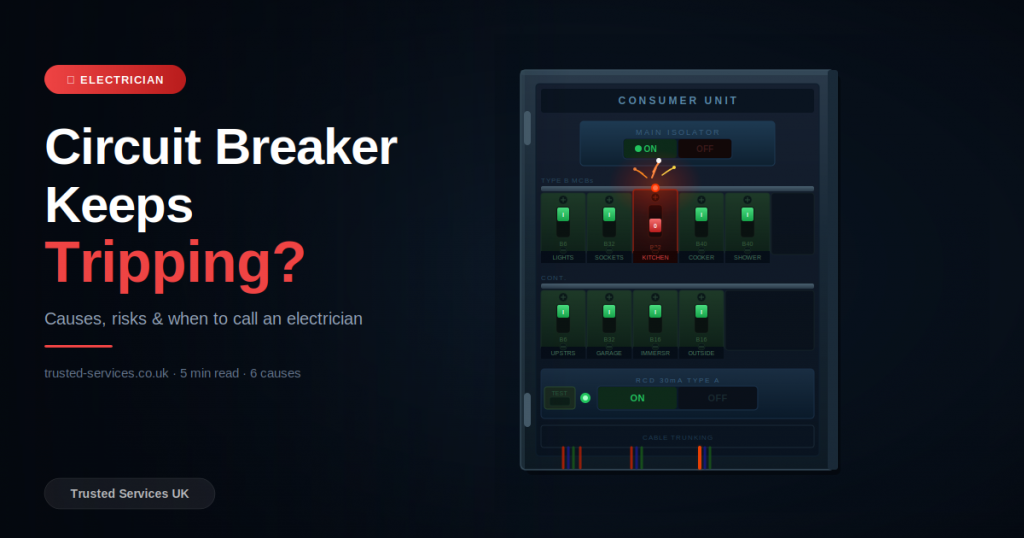
You hear a click, the lights go out, and you head to the fuse box again. You reset it — and ten minutes later, the same thing happens. If your circuit breaker keeps tripping, it’s your home’s electrical system telling you something is wrong. And unlike a one-off power cut, a repeatedly tripping breaker should never be ignored
In this guide, we cover the 6 most common reasons a circuit breaker trips in UK homes, explain what you can safely do yourself, and tell you exactly when the fault requires a qualified electrician.
| ⚡ KEY TAKEAWAYS |
| ✓ A breaker that trips once may just be an overloaded circuit — unplug appliances before resetting. |
| ✓ If it trips immediately after resetting, stop. This indicates a short circuit or wiring fault. |
| ✓ RCD (residual current device) trips are a different type of fault — often caused by a faulty appliance or moisture. |
| ✓ Never tape a breaker in the ‘on’ position or replace it with a higher-rated one — both are dangerous and illegal. |
| ✓ Repeated tripping on the same circuit always requires a qualified electrician to investigate. |
How Does a Circuit Breaker Actually Work?
A circuit breaker (also called an MCB — Miniature Circuit Breaker) is a safety switch inside your consumer unit (fuse box). Its job is to automatically cut power to a circuit when it detects too much current flowing through it. This protects your wiring from overheating and prevents fires.
When a breaker trips, the switch moves to the middle or ‘off’ position. The breaker can be reset — but only once you’ve addressed the cause. Think of tripping as a symptom, not the problem itself.
MCB vs RCD — Which One Is Tripping?
UK consumer units typically contain two types of protective device:
- MCB (Miniature Circuit Breaker) — protects individual circuits (lighting, sockets, cooker). Trips due to overload or short circuit.
- RCD (Residual Current Device) — protects against earth faults and electric shock. Usually covers multiple circuits and is the wider switch. Trips due to earth leakage — often a faulty appliance or moisture.
Knowing which device is tripping tells you a lot about the cause. Check your consumer unit label to identify whether it’s an MCB (individual circuit) or RCD (wider protection) that’s moving to the off position.
6 Most Common Reasons Your Circuit Breaker Keeps Tripping
1. Overloaded Circuit
The most common cause — and often the easiest to fix. An overloaded circuit occurs when you draw more power than the circuit’s rated capacity. This is common in kitchens and home offices where multiple high-wattage appliances share the same ring circuit.
Common signs of an overloaded circuit:
- Breaker trips only when multiple appliances are running at the same time
- Tripping happens in the kitchen, utility room, or home office circuits specifically
- The breaker feels warm when you go to reset it
Fix: Unplug high-draw appliances from the circuit. Spread them across multiple circuits or sockets on different circuits. If your home simply doesn’t have enough circuits for your needs, an electrician can add a dedicated circuit.
2. Short Circuit in an Appliance
A short circuit occurs when a live wire comes into contact with a neutral wire, causing a sudden surge of current. This often happens inside a faulty appliance — a damaged kettle, a washing machine with worn internal wiring, or a power tool with a damaged lead.
Unlike an overloaded circuit, a short circuit trips the breaker instantly — often with a popping sound or a burning smell. The breaker may feel hot.
Fix: Unplug all appliances on the affected circuit. Reset the breaker. Then plug appliances back in one at a time until the breaker trips again — that appliance is the culprit. Do not use it until it has been repaired or replaced.
3. Ground Fault (Earth Leakage)
A ground fault occurs when a live wire touches a grounded conductor or an earthed surface — inside a wall, in a damp location, or within an appliance. Ground faults are particularly common in bathrooms, kitchens, garages, and outdoor circuits where moisture is present.
Ground faults trigger the RCD rather than the MCB. If a wide section of your consumer unit is tripping (affecting lights, sockets, and other circuits simultaneously), a ground fault or faulty appliance causing earth leakage is likely.
Fix: Unplug all appliances in the affected area and reset the RCD. If it holds, plug items back in one by one. If the RCD trips immediately even with nothing plugged in, the fault may be in the fixed wiring — call an electrician.
4. Faulty or Worn Circuit Breaker
Circuit breakers are mechanical devices and they wear out over time. An old or failing MCB may trip at normal load levels — or may fail to reset at all. Breakers in consumer units older than 20–25 years are more likely to fail.
Signs of a faulty breaker: it trips at very low loads, won’t stay reset even with nothing on the circuit, or the switch itself feels loose or damaged.
Fix: Breaker replacement is not a DIY job. The consumer unit carries lethal voltages even when the main switch is off (the incoming supply cables remain live). A qualified electrician can replace an MCB safely, typically in under an hour.
5. Wiring Fault in the Fixed Installation
If you’ve ruled out appliances and the breaker still trips, the fault may be in the fixed wiring — inside walls, under floors, or at junction boxes. Wiring faults can be caused by rodent damage, nail penetration, insulation degradation in older cables, or poor workmanship from a previous installation.
Wiring faults are serious. They can cause arcing — the same mechanism responsible for the majority of electrical fires in UK homes. A wiring fault that repeatedly trips the same circuit must be investigated by a qualified electrician immediately
6. Nuisance Tripping from Sensitive RCDs
Modern consumer units use 30mA RCDs — highly sensitive devices designed to protect against fatal electric shock. This sensitivity is intentional and life-saving, but it can occasionally cause nuisance tripping: the RCD detects a tiny, harmless leakage current from multiple appliances combined and interprets it as a fault.
If your RCD trips infrequently with no obvious cause, and always resets without any fault being identified, it may be nuisance tripping from accumulated leakage across old appliances. A qualified electrician can measure earth leakage across your circuits and advise on whether appliance replacement or consumer unit reconfiguration would help.
| ⚠️ NEVER DO THIS: Never tape a tripped breaker in the ‘on’ position. Never replace a breaker with one of a higher rating to ‘stop it tripping’. Both actions remove the protection the breaker provides — and dramatically increase the risk of an electrical fire. If your breaker won’t stay reset, that is exactly when you need an electrician, not a workaround. |
How to Safely Reset a Tripped Circuit Breaker
Follow these steps in order — do not skip straight to resetting:
- Turn off or unplug all appliances on the affected circuit before touching the consumer unit
- Locate the tripped breaker in your consumer unit — it will be in the middle or ‘off’ position
- If it’s an RCD (wider switch), check whether moisture or a specific appliance may be the cause before resetting
- Push the breaker fully to ‘off’ first, then back to ‘on’ — some breakers must be fully off before they will reset
- If it holds, plug appliances back in one at a time to identify the culprit
- If it trips immediately on reset with nothing connected — call an electrician. The fault is in the wiring, not an appliance
When Should You Call a Qualified Electrician?
Call a qualified electrician without delay if:
- The breaker trips immediately on reset even with all appliances unplugged
- The same breaker trips repeatedly over days or weeks
- There is a burning smell, scorch marks, or a warm consumer unit
- Multiple circuits are tripping simultaneously
- The trip happened after recent building work, a new appliance installation, or a DIY project
- Your consumer unit is old — ceramic fuses, no RCD protection, or no labelling on the breakers
All work on your consumer unit and fixed wiring must comply with BS 7671 (IET Wiring Regulations) and Part P of the Building Regulations. Only use electricians registered with NICEIC, NAPIT, or an equivalent approved scheme.
The most common causes are an overloaded circuit, a short circuit in an appliance, a ground fault, or a failing breaker. If it trips repeatedly after resetting, a qualified electrician should investigate.
You can reset a tripped breaker once after unplugging appliances on that circuit. If it trips again immediately or repeatedly, stop resetting it — repeated tripping indicates a fault that resetting will not fix and could be dangerous.
A circuit breaker can be reset by flipping the switch back to ‘on’. A blown fuse must be physically replaced. Modern UK homes built or rewired after the 1990s will have a consumer unit with circuit breakers (MCBs) rather than fuses.
Yes. A short circuit inside an appliance is one of the most common causes of a tripped breaker. Unplug all appliances on the circuit, reset the breaker, then plug them back in one at a time until it trips again.
Replacing a single MCB typically costs £80–£150 fitted. If the issue is wiring, costs vary by fault location. A full consumer unit replacement costs £400–£800 on average. Always get a written quote before work begins.
Breaker still tripping? Find a local electrician on Trusted Services, or see our page for an electrician in Haringey covering Wood Green, Tottenham and Crouch End.

Trusted Services is a UK home services platform connecting homeowners and businesses with local tradespeople across roofing, plumbing, electrical, locksmith, cleaning and handyman trades. Our guides give clear, practical advice — whether you’re facing an emergency or planning ahead.